
The Law 251 Podcast
Episode 02 September 30, 2026
Desi Tobias on Maritime Law
As a new Jimmy Buffett exhibit opens at the Maritime Museum in Mobile, Desi Tobias talks about growing up on the Alabama coast and what makes someone a seaman.
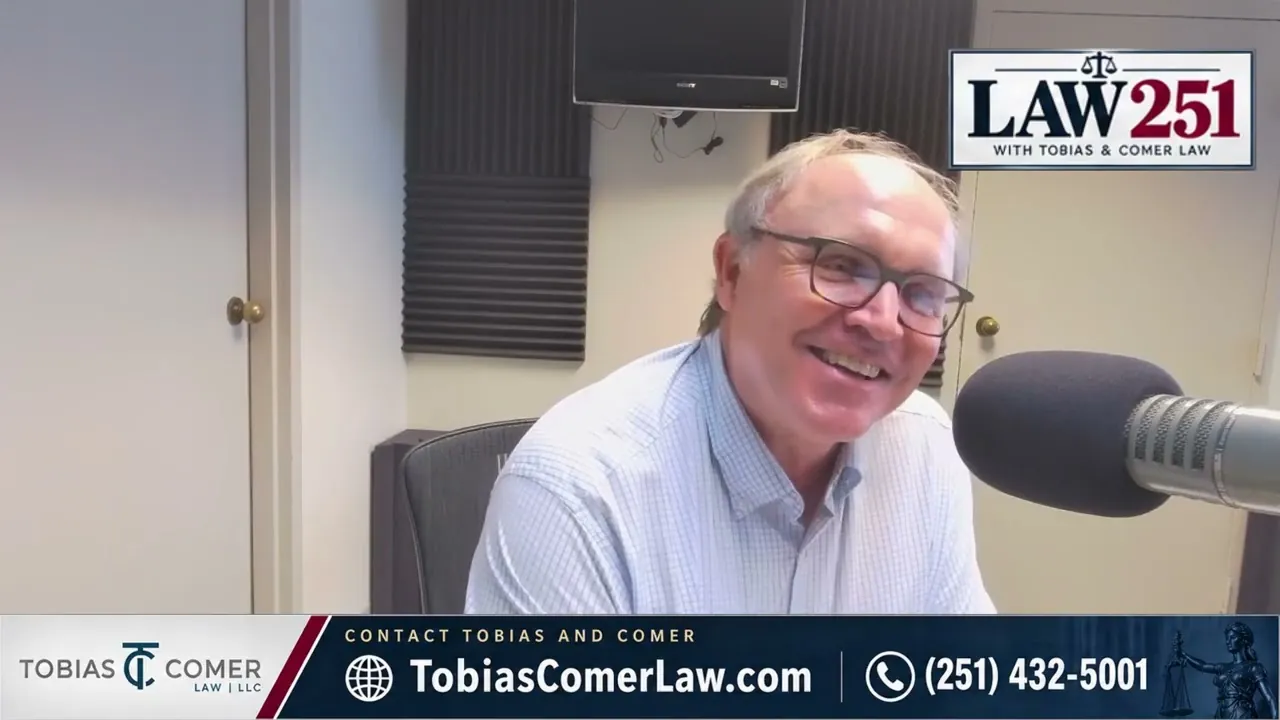
Original recording
Watch or listen to this episode.
This episode opens on the original third-party recording platform in a new tab.
Watch episode on YouTubeFrom the original episode page
Episode notes
As a new Jimmy Buffett exhibit opens at the Maritime Museum in Mobile, Desi Tobias talks about growing up on the Alabama coast and what the maritime industry means to our area.
He also explains what makes someone a seaman under maritime law and the special benefits that come with it.
Listen to the latest episode of Law 251.
Accessibility
Transcript
This transcript was prepared from the original episode audio and lightly edited for readability.
Dalton Orwig: Welcome back to Mobile Mornings on FM Talk 106.5. It's a pleasure to welcome Desi Tobias with Tobias & Comer Law this morning for another edition of Law 251. Desi, how's it going?
Desi Tobias: Great, Dalton. Good to see you.
Dalton Orwig: Always good to see you. There are some big events coming up. We've talked about Jimmy Buffett, and of course about maritime workers down here and how big a part of our economy they are. With the Son of a Son of a Sailor exhibit and the grand opening coming up, what an awesome time to be a Buffett fan. There are so many events around it, and going to the Maritime Museum once they add this new exhibit should be an awesome time.
Desi Tobias: I'm looking forward to it. That's a beautiful facility, and it's well run. They have a new manager, Karen Toth, and of course John Sledge is the historian there. It seems to me it's really performed well in the last few years. It's a beautiful facility right on the water, and the Jimmy Buffett exhibit is coming September 12th. My hope is that it really brings the public in. It made me think, because I've always enjoyed thinking about Jimmy Buffett. He went to McGill, where I went. I like his take on how he grew up, where he grew up, and how it influenced him. He was the son of a sailor. His grandfather was a ship's captain who went up the Mobile River, and his parents worked at the Alabama State Docks. Over the years, I've read that he would look out at the ships, think about what his grandfather had done, and dream about those faraway places. I was once a little boy sitting on a wharf at Mullet Point, Alabama, looking out at those ships and thinking, "Maybe one day I can work in that field," and wondering where they were going. That brings me to the topic I wanted to discuss, and that's the question: what is a seaman? What does that mean? It has huge significance in the legal field.
Dalton Orwig: We've talked previously about maritime workers and injury cases. This all comes back to the Jones Act, right, and what that entails?
Desi Tobias: It does come back to the Jones Act and whether you're eligible, as a seaman, for the benefits of the Jones Act. But it goes beyond that. When the Jones Act was enacted in 1920, it didn't define what a seaman is. What it gives is a cause of action for somebody who is employed on a vessel. What's a vessel? That's another term. And it's a right to a jury trial against your employer, with unlimited damages for pain, suffering, and everything else. One example I like to think about: there's a ship docked at the port, and somebody walks across the deck, falls, and breaks their leg. Same place, same ship, same area, but one person qualifies as a seaman for Jones Act benefits and the other is considered a longshoreman. For seaman status, you have to have a substantial connection to a vessel. There's a rule of thumb from the Supreme Court cases, and this is all Supreme Court law: is 30% of your time devoted to that ship?
Dalton Orwig: So that's the threshold they set, 30%.
Desi Tobias: Correct, 30%. If 30% of your time is spent on the vessel doing anything, and it doesn't even have to aid in navigation, that counts. One of the cases I have now involves somebody employed by one of the cruise ships. He's actually a musician. He was offstage when the ship rocked, and he fell into the fog machine. He's a seaman. He gets Jones Act status.
Dalton Orwig: Wow, that's amazing. Because that's a substantial part of his work life and income, he qualified by reaching that standard of time.
Desi Tobias: Yes, he met the Jones Act status and gets all those protections. Congress recognized back in 1920, when it passed the act, that it's a pretty rigorous and difficult occupation, and decided to give these workers these benefits. Again, that includes a jury trial and the right to a lot of things. But then there are people who don't have that connection to a vessel. A lot of the people who work here, like ship's electricians or people going on board who don't have a constant connection to the vessel, are longshoremen. That's a different scheme entirely. It's like your regular workers' comp system, with a defined benefit. You get paid fairly quickly, but it's just a percentage of your wages, often not a whole lot, and you get your medical care.
Dalton Orwig: So it might be somebody who spends a substantial amount of time on ships, but not one particular vessel. Say they work on vessels all the time, but on different vessels at different times. If they don't meet that 30% threshold, they're treated differently than someone who's on one ship all the time.
Desi Tobias: Correct. It's about that connection, the 30% of the time. And it can be a fleet. If you're an engineer working for a fleet, for example, you're connected to a vessel. Longshoremen are people working connected to a dock, a harbor, or the water, but their connection is to that place. They report to work there, not necessarily to a ship. There's a huge distinction between the two. The other question is what counts as a vessel, and that's another interesting area of the law. I recently had a case that turned on this. Somebody was working on a barge, something happened, and he died. We had to ask, is it a vessel? There's 1 U.S. Code Section 3, which is one of our earliest statutes, going back to 1790 or so.
Dalton Orwig: Wow, back in the powdered wig days.
Desi Tobias: Yes. It defines a vessel as every description of watercraft capable of being used as a means of transportation on water. So Huck Finn worked on a vessel. That's part of what we do as maritime lawyers. The case I had really turned on that issue. One side contended he was a longshoreman, and the longshoreman carrier was saying, "No, he's a seaman." Unfortunately, the widow and her children weren't getting paid because of this dispute. They also pointed out that a seaman has to prove some type of fault on the ship, and if there's no fault, there's no recovery. That's one of the downsides. It all hung in the balance for a while as we litigated that issue, and it really made me realize how important this interesting area of the law is.
Dalton Orwig: It's crazy, too, because it's such an old law, and it's been hammered out in the courtrooms since 1790. Over your career, you've seen how many different pathways there are in reading the Jones Act and all these definitions. It's absolutely fascinating. And it's so cool how it worked out for you. You talk about being a young boy, listening to Jimmy Buffett and seeing the parallels between your life and his and your love of the water, and now you're able to help so many people whose life's work is on the water.
Desi Tobias: It's really interesting in terms of the people you're helping. I've helped several shrimpers recently, and I always like to ask them, "Do you like it?" Somebody was in my office last week, and he said, "I love it." Several of them are seamen. I remember seeing the shrimp boats out in the bay. Sometimes they're moored during the day, and the crew is sleeping, and then they work through the night. I'd wonder, "What kind of life is that? It seems fun to me, but what do they think about it?" I really do enjoy helping those people. Recently, there were two people close to 60 who had been shrimpers since their teens. Those are Jones Act cases, because the Jones Act claim is against the employer and arises from employment as a seaman on a vessel. It has been gratifying in several of these cases to see the recovery come, especially when there's somebody with a family. Just like in a workers' comp case, that's your livelihood. That's where you make your money, and getting a recovery for that is all the more gratifying.
Dalton Orwig: I'm talking with Desi Tobias of Tobias & Comer Law for Law 251. One thing I wanted to ask about what qualifies you: what about employers trying to find loopholes, maybe classifying workers in ways that might help them if a case comes up? Have you seen any of that over the years?
Desi Tobias: I do. One of the things we're really concerned about these days is employers using arbitration agreements or employment agreements. The Jones Act gives you a right to a jury trial, it does, but a seaman can bargain away those rights, and I would be very careful about that. There's been a push in Congress to amend the Jones Act to address that. I was actually involved a week or two ago, in touch with somebody out of Florida who was working very closely on it, and I'm not sure where it went. My understanding was Lindsay Graham was very much on board with it and then suddenly passed. You've got to be very careful about the terms. Take the cruise ship musician I mentioned. Those big cruise lines like Carnival have plenty of lawyers to make sure you're stuck somewhere you don't want to be, rather than in front of a jury.
Dalton Orwig: Right. We've seen that in other industries as well, so it makes sense they'd do the same. What's great is that you know this stuff better than anyone I know, and you clearly love digging into the law, maritime law in particular, and helping maritime workers. You clearly have a passion for it. We have plenty of listeners who work on the water day in and day out, or have friends or family who do. Tobias & Comer Law is so accessible, whether someone gets on the phone with you or just comes by and knocks on the door on Dauphin Street. They can call 24/7 at 251-432-5001, and a free consultation is on the other end of the line. Is that what you'd encourage someone with questions about what we talked about today to do?
Desi Tobias: Absolutely. Anybody with any kind of sea-based or water-based employment just doesn't know what may or may not apply. It may seem obvious or not, but please call us. We're always happy to talk, and I'm always happy to talk through these things.
Dalton Orwig: And also visit tobiascomerlaw.com. I talk about your website all the time, but it's a really good one. Of course it has information about the firm and everyone working there, and you have such a great team. Beyond that, it has information you can actually use in your day-to-day life, whether that's about the kinds of cases you've seen in the courtroom over the years, checklists for getting your kids ready for school, or car seat questions for a newborn in the family. You've got it all covered at tobiascomerlaw.com. Desi, as always, I learn so much when you come into the studio. I appreciate you coming on Mobile Mornings today.
Desi Tobias: Thank you, Dalton. Always great to see you. I appreciate all you do for us.
Dalton Orwig: Thank you, sir. That's Desi Tobias with Tobias & Comer Law. Again, you can find out more at tobiascomerlaw.com. That does it for us here on Mobile Mornings. Hope you have a great rest of your day.